
From powder to injectable — the complete protocol.
What You'll Need
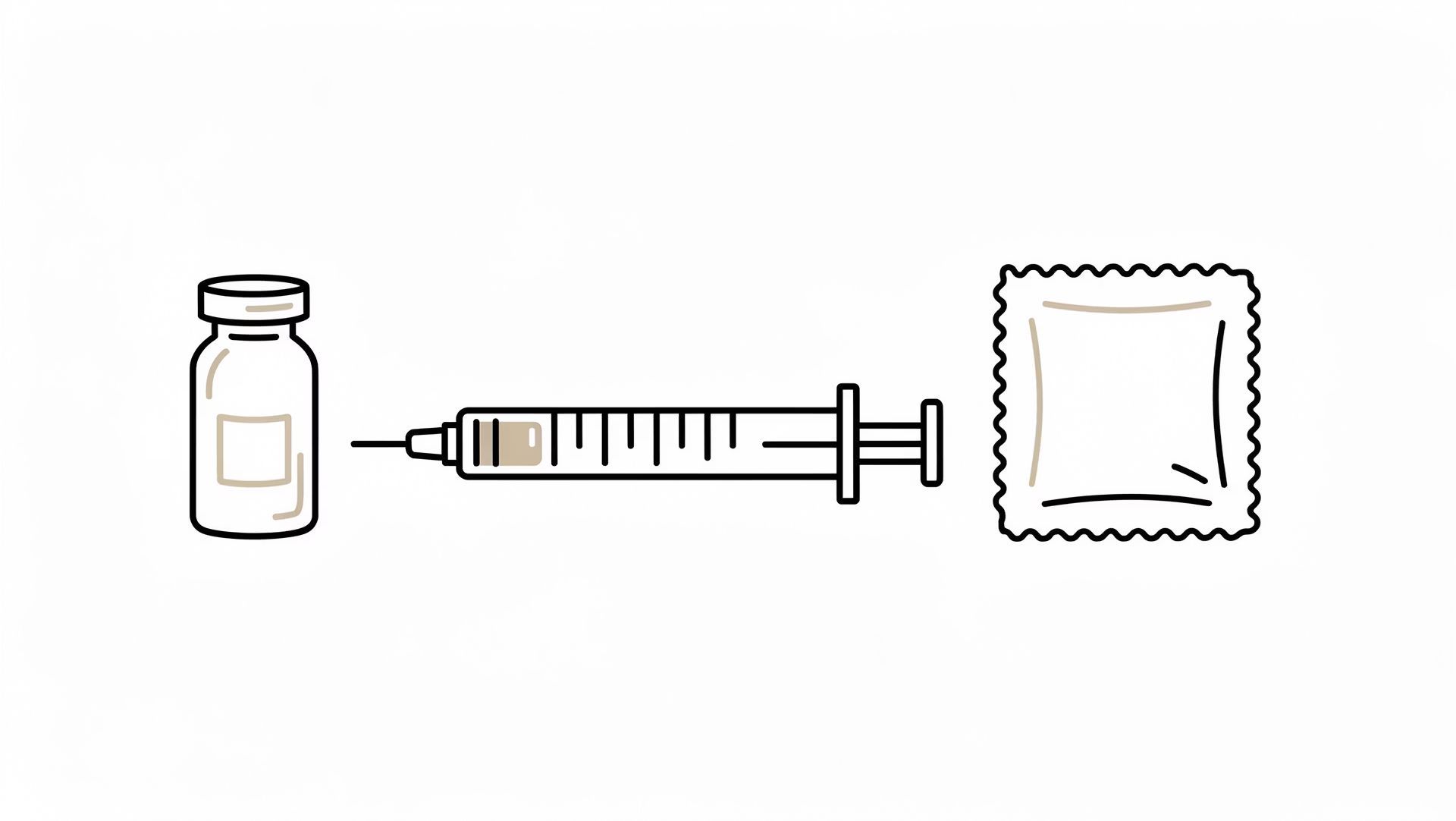
Lyophilized Peptide Vial
Your freeze-dried peptide powder. Keep refrigerated and away from UV light until ready to use.
Bacteriostatic Water (BAC Water)
Sterile water with benzyl alcohol to prevent bacterial growth. Do not substitute with tap water, plain saline, or plain sterile water for multi-use vials.
Insulin Syringe (1 mL, 29–31 gauge)
Standard insulin-style syringe for drawing and injecting. Short needle for SubQ; longer for IM.
Alcohol Swabs
For wiping vial stoppers before every draw and cleaning the injection site.
Sharps Container
For safe needle disposal. Never recap and toss in regular trash.
Foil or Dark Storage
To protect reconstituted vials from light degradation.
Step 1 — Reconstitution (Mixing the Peptide)
Gather Your Supplies
Peptide vial, BAC water vial, insulin syringe, and alcohol swabs. Work on a clean, flat surface.
Wipe Both Vial Stoppers
Use a fresh alcohol swab on the stopper of both the peptide vial and the BAC water vial. Let them air dry for 10–15 seconds.
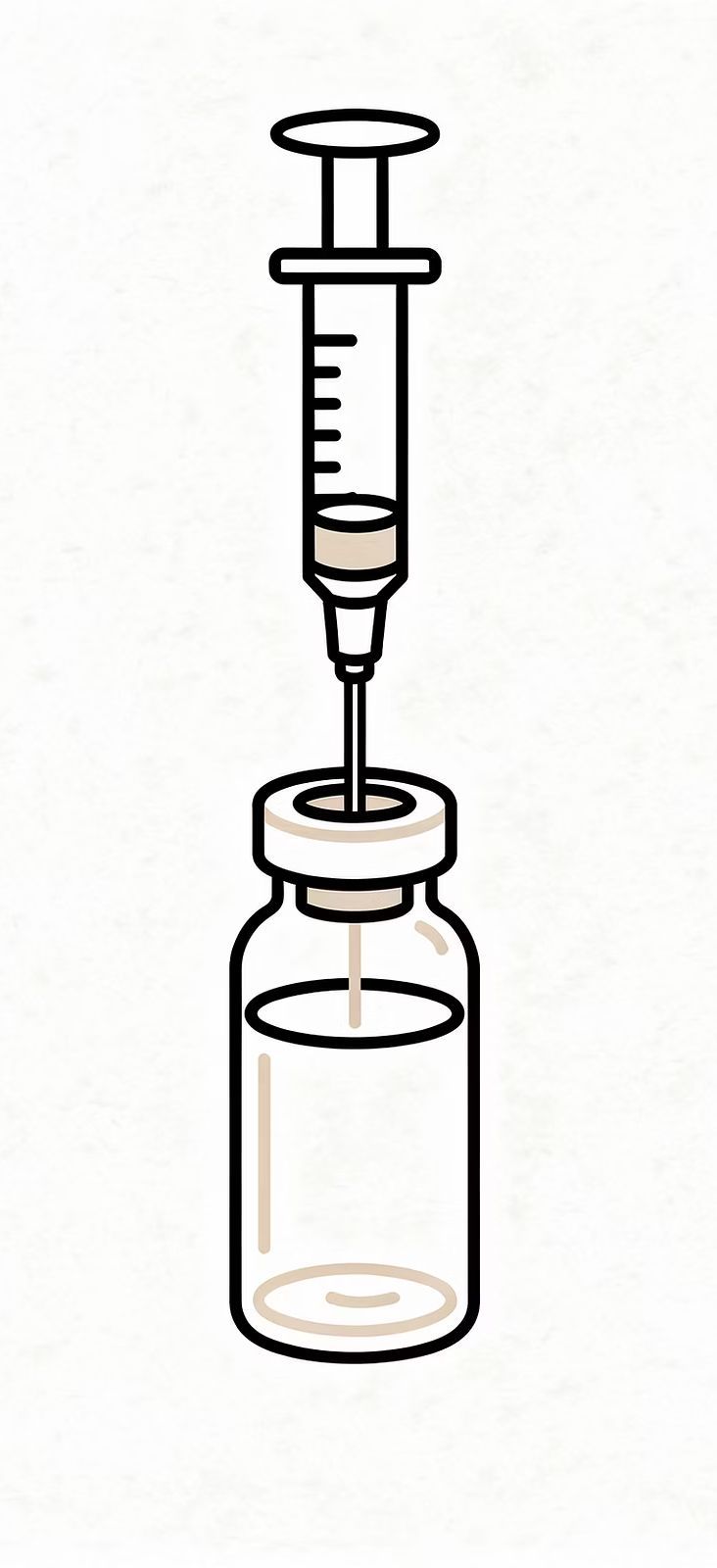
Draw the BAC Water
Insert the syringe needle into the BAC water vial. Draw 1–2 mL (the exact amount determines your concentration — see dosing math below).
Inject Slowly Down the Wall
Insert the needle into the peptide vial. Angle the needle so the BAC water runs slowly down the inside wall of the vial — do not shoot it directly onto the powder. This prevents foaming and degradation.
Do Not Shake
Gently swirl the vial in a slow circular motion until the powder is fully dissolved. The solution should be clear. If it's cloudy or has particles, do not use it.
Label and Store
Write the date on the vial. Refrigerate immediately. Keep away from light — wrap in foil or store in a dark container. Do not freeze.
Dosing math example: 5 mg peptide vial + 2 mL BAC water = 2,500 mcg per mL. A 100 mcg dose = 0.04 mL = 4 units on an insulin syringe.
Step 2 — Loading the Syringe
Remove the Vial From the Fridge
Let it sit for 1–2 minutes to reach room temperature. Cold liquid can cause minor stinging on injection.
Wipe the Stopper
Use a fresh alcohol swab on the vial stopper. Let it air dry.
Draw Air First (Optional)
Pull back the plunger to draw a small amount of air equal to your dose. Inject that air into the vial before drawing — this creates positive pressure and makes drawing easier.
Draw Your Dose
Insert the needle, invert the vial, and slowly pull back the plunger to your target volume. Go slightly past, then push back to the exact mark to remove air.
Tap Out Air Bubbles
Hold the syringe needle-up and tap the barrel. Push the plunger gently until any air bubbles are expelled and a small drop appears at the needle tip.
You're Ready
Cap the needle carefully if not injecting immediately. Inject within a few minutes of drawing.
Step 3 — Choosing Your Injection Site
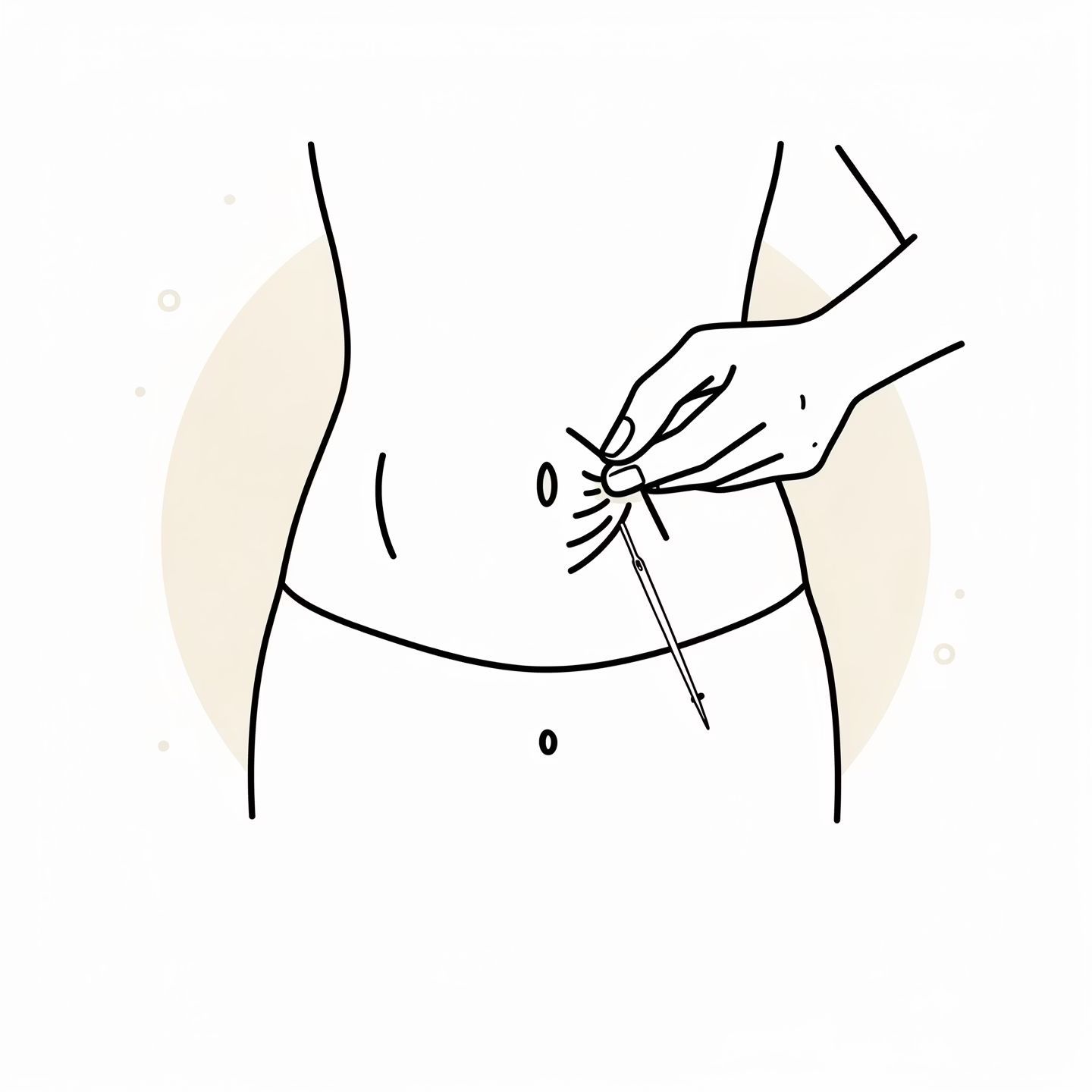
Abdomen — SubQ
Best for beginners
Pinch 2 inches from belly button
45° angle into the fold
Slow absorption, very forgiving
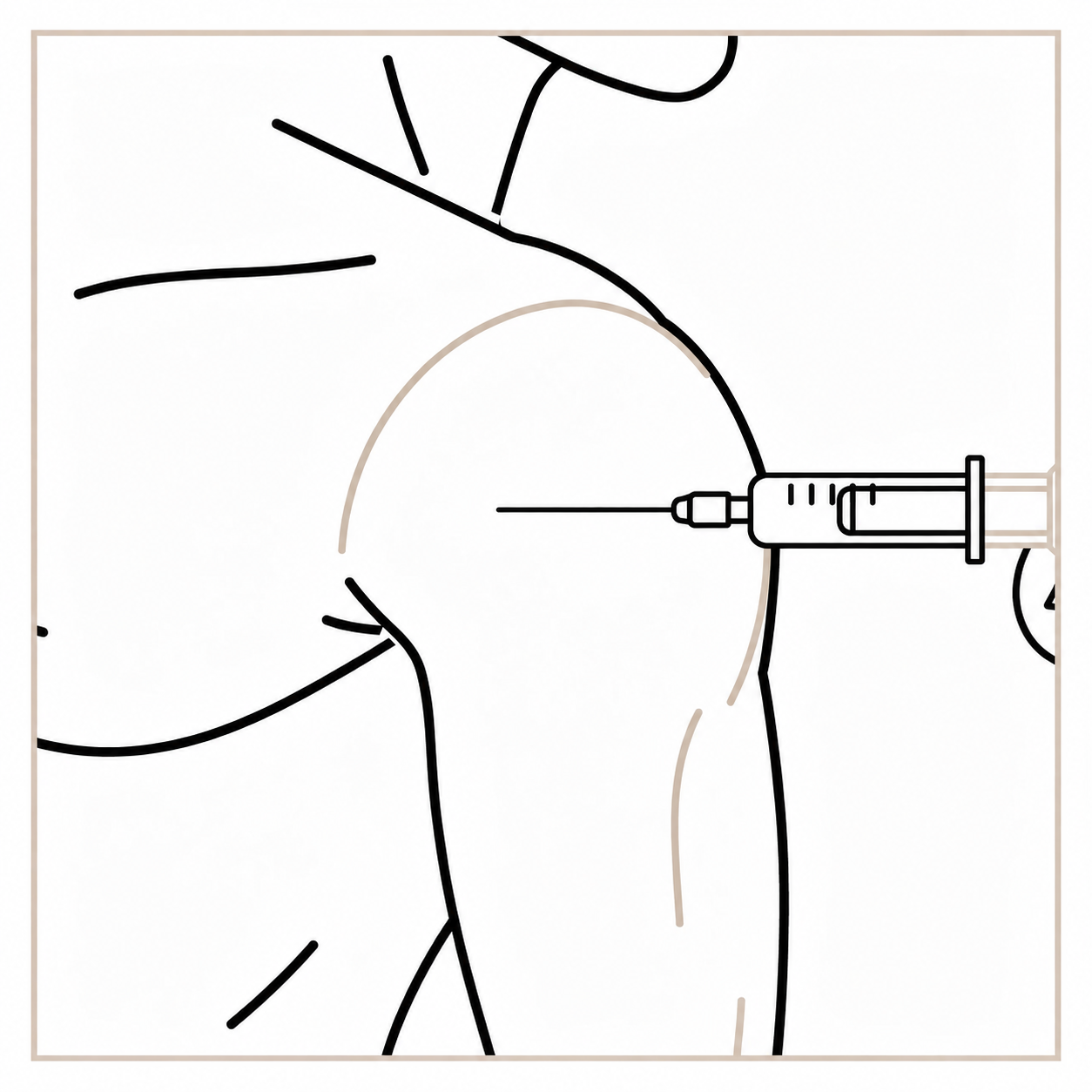
Side Delt — IM
Best first IM site
Easy to self-inject, no flexibility needed
90° angle, relax the arm
Faster absorption than SubQ
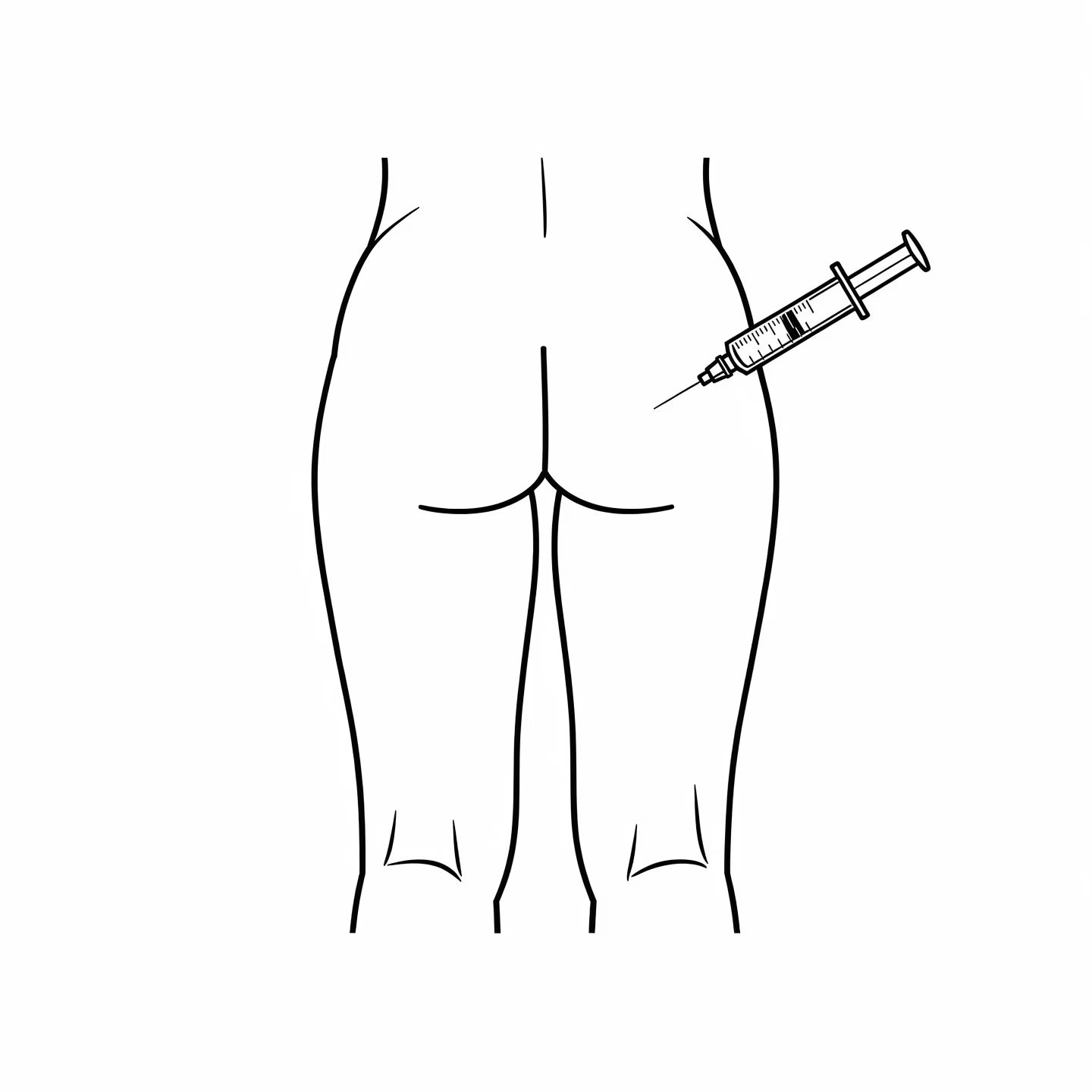
Upper Outer Glute — IM
Good once comfortable
Upper outer quadrant ONLY
90° angle, stand and relax
Requires flexibility to reach solo
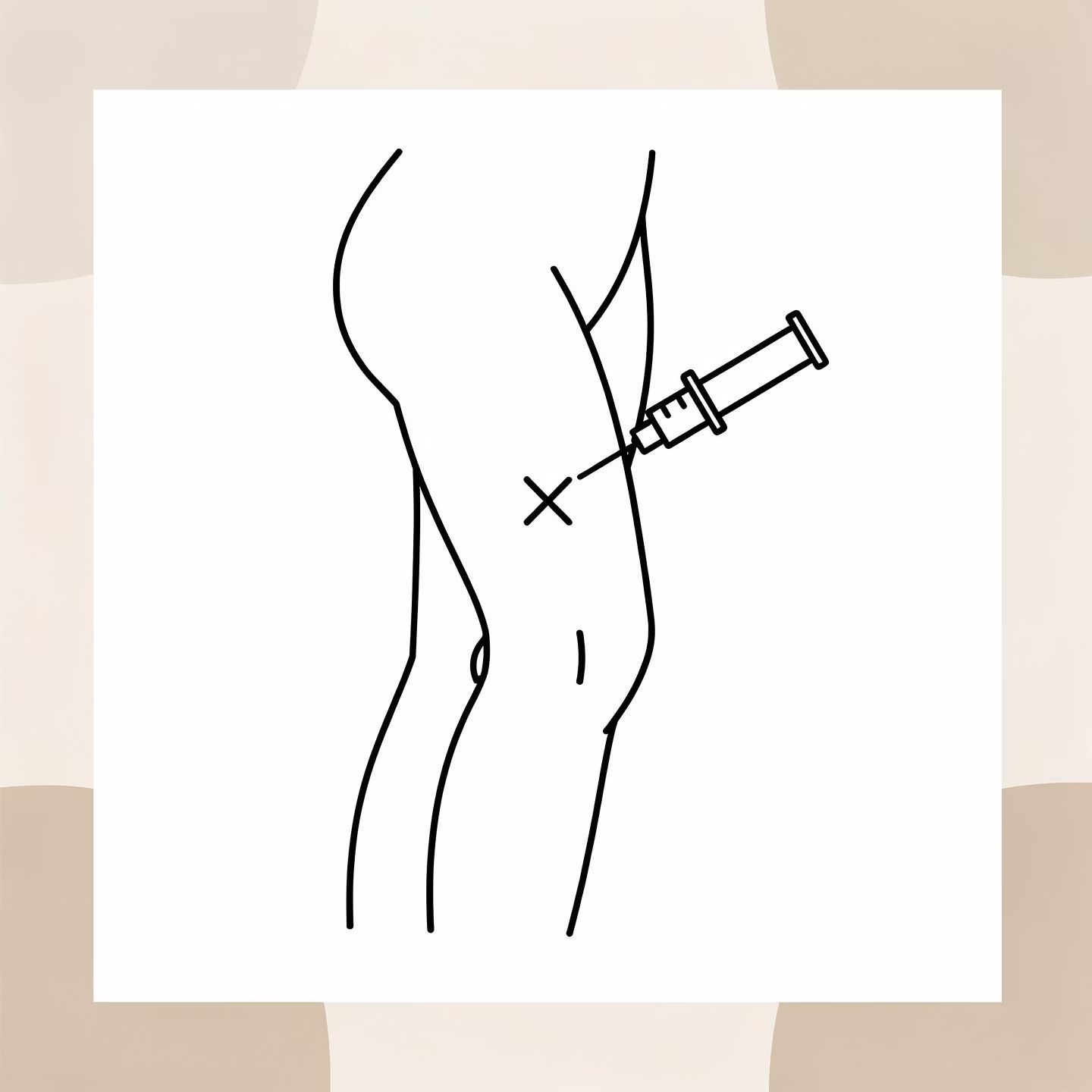
Outer Thigh — IM
Easy to self-inject
Middle third of outer thigh
90° angle, seated or standing
Good alternative to delt
Our preference: IM for daily protocols. SubQ abdomen is the recommended starting point for beginners.
Always inject into the upper outer quadrant of the glute — not the center or lower portion. Avoid the sciatic nerve zone.
Step 4 — The Injection (Technique)
Glute or Delt (IM — Intramuscular)
Relax the muscle completely — don't flex
Clean the site with an alcohol swab, let it air dry
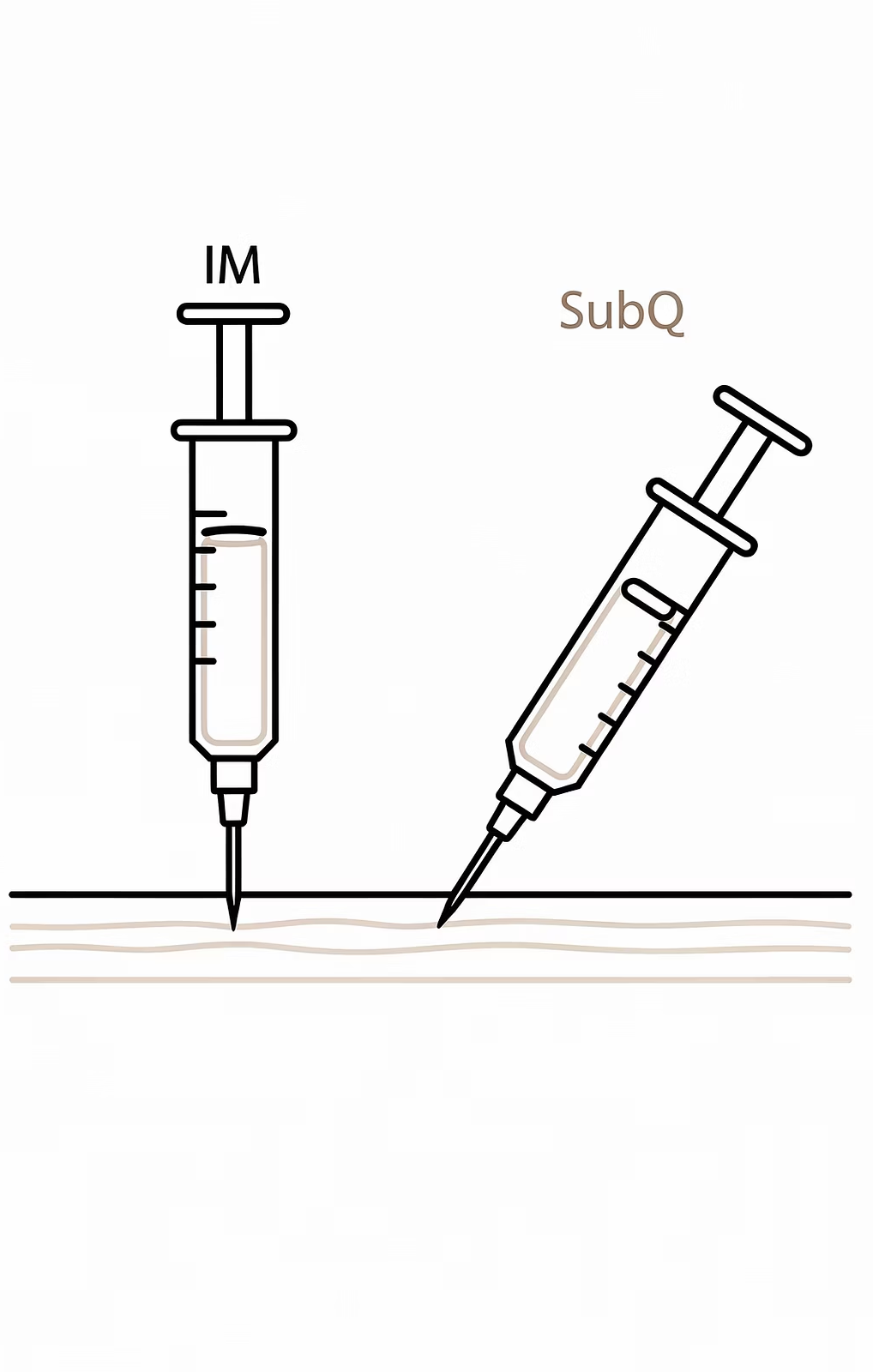
Insert the needle straight in at 90 degrees, smooth and confident — hesitation causes more pain
Inject slowly and steadily — don't rush the plunger
Withdraw the needle at the same angle
Apply light pressure with a clean swab — do not rub
Abdomen (SubQ — Subcutaneous)
Pick a spot 2 inches from the belly button
Pinch the skin and fat — lift it up and hold
Insert the needle at 45 degrees into the pinched fold
Inject slowly and steadily
Withdraw the needle, release the pinched skin
Apply light pressure — do not rub
Needle reuse: Studies on insulin users show reusing needles is acceptable for the same person when not contaminated. Replace approximately once per week or sooner if it feels dull. Never share needles.
Sterile Technique — Why It Matters & How to Maintain It
Your Needle Is Sterile Once — Treat It That Way
The moment a needle touches anything other than the inside of a sterile vial or your cleaned injection site, it is no longer sterile. This includes your fingers, the table, the cap interior (after first use), and the air if left uncapped too long. One contaminated injection can cause a serious abscess or infection.
Never Touch the Needle
Do not touch the needle shaft or tip with your fingers, clothing, or any surface. If you accidentally touch it — replace it. No exceptions.
Cap Protocol
Keep the needle capped until the moment of injection. After drawing your dose, recap carefully using the one-hand scoop method — set the cap on a flat surface, scoop it onto the needle without using your other hand. Never recap by holding the cap in your fingers.
One Needle, One Use — Or Know the Rules
Ideally, use a fresh needle for every injection. If reusing (same person only, never shared), inspect the tip — a dull or bent needle causes more tissue damage and pain. Replace at minimum once per week.
Alcohol Swab Everything, Every Time
Wipe the vial stopper before every draw. Wipe the injection site before every injection. Let both air dry completely — wet alcohol on the skin can sting and slightly compromise the sterile field.
Work Clean
Use a clean, flat surface. Wash hands before handling any supplies. Don't sneeze or cough over open vials or uncapped needles. Keep your kit closed when not in use.
Sterile technique isn't about being paranoid — it's about making contamination impossible by default. Build the habit once and it becomes automatic.
Peptide Calculator — Mixing to Your Dose
The goal is simple: mix your peptide so that a standard, easy-to-measure amount on the syringe equals your daily dose. We typically mix so that 5 ticks (units) on an insulin syringe = one daily dose. This keeps every draw consistent, fast, and foolproof.
The Standard Mix Method
An insulin syringe has 100 units per mL
5 ticks = 5 units = 0.05 mL
So you want your daily dose to equal 0.05 mL of your reconstituted solution
Work backwards: if your daily dose is X mcg, divide by 0.05 to get your concentration (mcg/mL), then add that much BAC water
Example: 5 mg (5,000 mcg) vial, daily dose = 250 mcg → 250 mcg ÷ 0.05 mL = 5,000 mcg/mL → Add exactly 1 mL of BAC water → Now 5 ticks on the syringe = 250 mcg every time ✓
Why This Method Works
Eliminates math at every draw — just pull to 5 ticks and go
Reduces dosing errors from miscalculation
Keeps all your peptides on the same system — easier to track multiple compounds
Use a peptide calculator online to verify your mix before reconstituting (search: "peptide reconstitution calculator")
Once you dial in your mix ratio, write it on the vial with a marker
Pro tip: If your dose changes, remix a new vial rather than trying to adjust on the fly. Consistency in your mix = consistency in your results.
Storage, Handling & Quick Reference Rules
Storage Rules
Dry powder (unreconstituted): refrigerate, keep away from UV light and heat
Reconstituted vials: refrigerate immediately after mixing
Do NOT freeze reconstituted vials — freezing degrades the peptide
Wrap vials in foil or store in a dark container to block light
Discard reconstituted vials after 4–6 weeks
Most dry powder is stable for months refrigerated
Physical Storage / Case Info
Store vials in a hard case, pouch, or opaque container — light is one of the primary causes of peptide degradation
A simple pill case, travel case, or any dark/opaque container works
Never leave vials on a countertop, windowsill, or anywhere with ambient light exposure
When traveling: keep in a small insulated case with an ice pack — do not let them freeze
The goal is: dark + cold + stable. Any case that achieves that works.
Every-Use Checklist
Wipe vial stopper with alcohol swab before every draw
Use a clean syringe for every injection
Let injection site air dry after swabbing
Rotate sites every session
Inject slowly — never rush the plunger
Dispose of needles in a sharps container
Log your injection site and dose
Red Flags — Stop & Reassess
Cloudy or particulate solution — do not inject
Vial has been unrefrigerated for extended time — discard
Injection site shows redness, swelling, or warmth beyond 24 hours
Fever after injection
Severe or unusual pain at injection site
If you experience signs of infection (increasing redness, warmth, swelling, pus, or fever) at an injection site, seek medical attention. Improper technique or contaminated product can cause serious complications.
BEST PRACTICES
The Short Version
Mix smart
Use the 5-tick method. Dial in your ratio once, write it on the vial, never do math again.
Stay sterile
One touch = compromised. Swap the needle, start over. No shortcuts.
Swab and dry
Alcohol swab every stopper, every site, every time. Let it dry before you inject.
Inject slowly
Never rush the plunger. Slow and steady reduces pain and tissue irritation.
Rotate sites
Same spot every day = scar tissue. Rotate every session.
Store dark and cold
Fridge, foil, case. Light and heat are the enemy.
Don't freeze
Reconstituted peptides die in the freezer. Cold ≠ frozen.
Label everything
Date on every vial. Know what's in it and when you mixed it.
Know your red flags
Cloudy solution, fever, swelling past 24 hours — stop and reassess.
Do your homework
Know the peptide, know the dose, own the decision.